Analog Computer – Powerful Yet Limited in Modern Tech Use
Published: 27 Oct 2025
Did you know that the first analog computer was built long before digital computers even existed? Analog computers were used to solve complex math and science problems using electrical or mechanical parts instead of codes or binary data. They helped scientists, engineers, and researchers make calculations faster and simulate real world systems accurately.
What is an Analog Computer?
People use analog machine to solve problems with continuous data. Analog computing handles real world changes like speed or temperature. Analog computer examples include simple tools like slide rules. Analog computer is a type of computer.
An analog computer revival happens now because it saves energy. Modern analog machine help with quick tasks in AI. They work well where digital ones use too much power.
History of analog computers shows early tools from ancient times. Famous analog machine like the antikythera mechanism predicted stars. Analog systems timeline starts long ago and grows with tech.
History of Analog Computers
Early people built mechanical analog computers with gears and water. They measured time and tides. Tools like tide predictor helped predict sea levels.

Development of electronic analog computer came in the 1940s. Engineers used voltages for fast math. Operational amplifier analog machine made this possible.
Analog machine in World War II guided guns and bombs. Vannevar Bush analog computer solved hard equations. Analog machine in space exploration planned rocket paths.
1. Early Mechanical Analog Computers
The first analog computers used gears, wheels, and levers to perform calculations. The Antikythera mechanism from ancient Greece is the oldest known example. This device predicted astronomical positions and eclipses using bronze gears. Sailors discovered it in a shipwreck in 1901.
Mechanical analog computers became more common in the 1800s. The tide predictor helped sailors know when tides would rise and fall. Engineers built machines that could predict planetary motion. These devices used physical movement to represent mathematical relationships.
The slide rule analog machine served mathematicians and engineers for centuries. This simple tool used logarithmic scales to multiply and divide. Students learned to use slide rules in schools until electronic calculators appeared. Many vintage analog computers still exist in museums today.
2. Development of Electronic
Electronic analog computers emerged in the early 1900s. These machines used electrical signals instead of mechanical parts. The operational amplifier became a key component for electronic analog computing. Scientists could now solve equations much faster.
Vannevar Bush created one important electronic device in 1931. The Vannevar Bush analog computer could solve differential equations automatically. This machine opened new possibilities for scientific research. Universities and laboratories built similar devices for their work.
World War II accelerated development of these machines. Engineers needed to calculate artillery trajectories quickly. The analog systems in World War II helped aim weapons and guide aircraft. Military applications drove many innovations in analog technology.
3. Role in War and Space Exploration
Military needs shaped analog design during wartime. The analog flight simulator trained pilots without risking lives or aircraft. Gun directors used analog circuits to track moving targets. These applications required real-time calculations.
After the war, scientists used analog computers for peaceful purposes. The analog technology in space exploration helped calculate rocket trajectories. Engineers modeled orbital mechanics using these machines. NASA relied on analog systems alongside digital computers for moon missions.
Control systems in rockets used analog feedback systems to maintain stability. These computers processed sensor data continuously. The analog systems in control systems proved reliable for critical operations. Space agencies trusted these machines for important calculations.
Learn more about an example of analog computers: 20 Examples of Analog Computers
How Analog Computers Work
These machines process information differently than digital computers. Understanding the basic principles helps explain their unique capabilities. The working method relies on physical quantities and continuous changes.
1. Basic Working Principle
An analog machine represents numbers as physical measurements. Voltage levels can stand for temperature values. Shaft rotation can represent velocity. The machine manipulates these physical quantities to solve problems.
Components connect in circuits that model mathematical equations. Each part performs a specific operation like adding or multiplying. The analog adder combines two input signals into one output. The analog multiplier creates a signal proportional to two inputs multiplied together.
Results appear as measurements on meters or graphs. An analog plotter can draw solution curves automatically. Scientists read answers from dials or oscilloscope screens. The continuous nature of signals allows smooth, flowing results.
2. Signals and Processing
Analog signal processing works with smoothly changing values. Unlike digital signals that jump between discrete levels, analog signals flow continuously. This property makes them ideal for modeling real-world phenomena. Temperature, pressure, and sound all change gradually in nature.
The analog simulation technique creates physical models of systems. Engineers can simulate airplane behavior or bridge stress. The computer uses electrical circuits that act like the real system. This approach helps test designs before building expensive prototypes.
Signal quality matters greatly in analog computing. Noise and interference can corrupt results. The analog computer noise problem requires careful design and shielding. Engineers use various analog noise reduction techniques to maintain accuracy.
Types of Analog Computers
Different types fit various needs. Mechanical ones move parts. Electronic ones use power. Mechanical analog computer suits basic tasks. Electronic analog computer fits complex ones. Hybrid analog digital computer joins both worlds. Analog optical computing uses light. Photonic analog computer speeds things up. Memristor analog computer stores data new ways. 3 types of analog computers included are:

- Mechanical Analog Computers
- Electronic Analog Computers
- Hybrid Analog Digital Computers
Explain each type of analog computer in detail
1. Mechanical Analog Computers
These machines use physical parts to perform calculations. Gears mesh together to multiply values. Springs and levers represent forces and distances. The mechanical analog computer dominated early computing history.
Advantages include simplicity and reliability. No electrical power is needed for basic mechanical devices. Users can see the physical representation of calculations. However, these machines are slower and bulkier than electronic versions.
2. Electronic Analog Computers
Electronic versions replaced mechanical parts with circuits. Vacuum tubes and later transistors processed signals. The electronic analog computer offered much faster operation. Electrical signals travel at nearly the speed of light.
These machines became standard in laboratories and research centers. The operational amplifier analog computer design became widely adopted. Universities taught students how to program these systems. Electronic versions could solve complex differential equations in seconds.
3. Hybrid Analog Digital Computers
Combining both technologies creates powerful tools. The hybrid analog digital computer uses each type for its strengths. Analog circuits handle continuous calculations while digital circuits control and store data. This combination provides flexibility and precision.
Modern systems often use hybrid approaches. Digital computers can simulate analog behavior. The analog to digital conversion allows both types to work together. Interface circuits translate between continuous and discrete signals.
Applications of Analog Computers
Analog computers are used in many fields to solve complex problems quickly. They help in science, engineering, and education by running analog simulations and processing continuous signals. Modern analog computers are also applied in AI, physics, and real-time system modeling. Here are some applications of analog computers.
Uses of Analog Computers:
- Use in physics
- It is use in engineering
- Structural analysis using analog methods
- Electrical circuit simulation
- Analog-based filter design
- Fluid dynamics modeling
- Seismic modeling techniques
- It is use in geology
- It is use in civil engineering
- Control system applications
- Feedback system operations
- There are use in aerospace
- Flight simulator systems
- It is use in education
- School projects using analog systems
- Science fair demonstrations
- Tutorial programs for learners
- Experimental learning setups
- Project-based learning tools
- Online learning platforms
- MOOCs for analog learning
- Computing course programs
- Skill-building bootcamps
- Weather prediction models
- Meteorology research applications
- Use in biology
- Biological simulation systems
- Use in economics
- Economic modeling techniques
- Synthesizer-based computing
- Music technology systems
- Creative art generation
- Generative art techniques
- Chaos-based computing
- Strange attractor modeling
- Fractal pattern generation
- It is use in AI
- Machine learning computations
- Neural network modeling
- Neuromorphic computing methods
- Reservoir-based computing
- Security research applications
- Data cryptography systems
- Steganography techniques
- Privacy protection methods
- Ethical computing practices
- Environmental impact analysis
- Sustainable computing approaches
- Recycling and reuse programs
- Revival of analog systems
- Energy-efficient designs
- New computing paradigms
- Future computing possibilities
- Innovative computing models
- Breakthrough technologies
- Latest research developments
- Industry news and trends
- Trends for the year 2025
- Optical-based computing
- Photonic system models
- Memristor-based technology
- Biomimicry applications
- Bio-inspired system modeling
- Evolutionary algorithm design
- Genetic programming models
- Swarm intelligence research
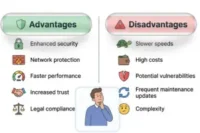
Advantages and Disadvantages of Analog Computer
Every technology has strengths and weaknesses. Understanding both helps choose the right tool for each job. Analog machine excel in some areas but struggle in others.
| Benefits of Analog Computer |
|---|
|
| Disadvantages of Analog Computer |
|---|
|
Components of an Analog Computer
Analog use physical parts to solve problems with continuous data. These components work together to process signals like voltage or motion. They form the heart of analog computing systems. Here are common components of analog computers.
- Analog integrator
- Analog multiplier
- Analog adder
- Operational amplifier analog computer
- Analog sensors
- Analog actuators
- Analog input devices
- Analog output devices
- Analog displays
- Analog plotters
- Analog oscilloscopes
- Analog multimeters
- Analog computer peripherals
- Analog microcontroller
- Analog FPGA
- Analog ASIC design
- Analog VLSI
- Analog chip fabrication
- Analog semiconductor
- Analog quantum dots
- Analog nanotechnology
Programming and Optimization
Operating an analog computer differs from digital programming. The process involves physical configuration rather than typing code. Understanding these techniques helps users get accurate results.

How Analog Computers Are Programmed
The analog computer programming starts with equation analysis. Users identify the mathematical relationships to solve. Each operation maps to a specific circuit component. Wiring diagrams show how components connect.
Patch panels allow flexible configuration. Users plug cables between terminals to create circuits. Each cable represents a connection in the mathematical model. Different problems require different wiring patterns.
Component values must be set carefully. Potentiometers adjust gain and scaling factors. Calibration ensures accurate representation of problem variables. The analog calibration techniques require patience and skill.
Testing verifies correct operation. Engineers apply known inputs and check outputs. Analog computer experiments help validate the setup. Troubleshooting analog computers requires systematic checking of connections and components.
Optimization Techniques
The analog machine for optimization solves problems by finding best solutions. These machines excel at continuous optimization tasks. Engineers use them to minimize energy use or maximize efficiency.
Various algorithms can be implemented with analog circuits. Though the list of optimization methods mentioned in keywords is extensive, practical analog implementations focus on gradient-based approaches. The computer follows paths toward optimal solutions. Physical analog systems naturally seek minimum energy states.
Modern research explores bio-inspired methods. Neuromorphic systems mimic how brains optimize learning. These approaches may lead to efficient new analog architectures. Research in analog systems research continues to explore possibilities.
The analog computer benchmarks measure performance against standards. Researchers compare speed, accuracy, and energy use. The analog performance varies by application and design. Testing helps identify best use cases.
Modern Developments and Future
Technology continues advancing in surprising directions. Analog machine is experiencing renewed interest. New applications and hardware designs are emerging.
Revival of Analog Computing
The analog computer revival comes from multiple factors. Energy concerns drive interest in efficient computing. Climate change awareness makes power consumption important. Analog systems use less energy for certain calculations.
Specialized applications benefit from analog approaches. Problems with continuous variables suit analog methods. Real-time control systems need instant response. Digital conversion delays can be eliminated.
Research institutions are building new machines. Universities teach analog computing paradigms to students. Companies explore commercial applications. The analog computing community shares knowledge and resources.
Analog Computing in AI and Machine Learning
Artificial intelligence may benefit from analog methods. The analog computer in AI mimics biological neural networks. Brain-inspired computing uses continuous signals like neurons. This approach might overcome limitations of digital AI.
The analog computer in machine learning processes patterns efficiently. Training neural networks requires massive calculations. Analog neural networks could reduce energy requirements dramatically. Researchers test prototypes to prove concepts.
Neuromorphic chips combine analog and digital elements. These devices process sensory data efficiently. Applications include robotics, autonomous vehicles, and edge computing. The technology is still developing but shows promise.
Reservoir computing analog systems use dynamic physical processes. These computers exploit natural complexity for computation. Water waves, mechanical vibrations, or electrical circuits can serve as reservoirs. This unconventional approach opens new possibilities.
Emerging Hardware
New materials enable novel analog designs. The memristor analog computer uses resistors with memory. These components change resistance based on history. They can store and process information simultaneously.
Optical systems offer incredible speed. The photonic analog computer uses light beams instead of electricity. Calculations happen at light speed with minimal heat generation. The analog optical computing field is expanding rapidly.
Quantum effects inspire new analog approaches. Though different from quantum computers, some analog systems exploit quantum phenomena. These experimental devices push boundaries of physics and computation. The analog computer vs quantum computer comparison shows distinct approaches to computing.
Nanotechnology enables tiny analog circuits. The analog nanotechnology research creates components at molecular scale. Smaller devices use less power and space. Integration density could rival digital circuits.
Biological inspiration guides development. The analog biomimicry approach copies nature’s solutions. Natural systems are inherently analog and efficient. Bio-inspired analog computing learns from millions of years of evolution.
DIY and Educational Projects
Anyone can explore analog computing through hands-on projects. Starting small helps build understanding and skills. Many resources support learning at various levels.
How Beginners Can Experiment
Building a simple circuit is a good starting point. The analog computer DIY community shares designs and instructions. Basic operational amplifier circuits demonstrate fundamental concepts. Electronic hobby stores sell necessary components inexpensively.
The build analog projects range from simple to complex. Beginners might create an analog adder using resistors and op-amps. Intermediate builders can construct integrators and multipliers. Advanced projects might solve actual differential equations.
Online tutorials guide learners step by step. The analog machine tutorial resources explain theory and practice. Videos show assembly and testing procedures. Forums allow builders to ask questions and share results.
School projects analog computer demonstrations engage students effectively. Building circuits reinforces mathematical concepts. The analog computer science fair projects showcase creativity and technical skill. Teachers find these activities motivate learning.
Software Simulations and Virtual Analog Computers
Not everyone can build physical circuits easily. The analog computer software simulation provides virtual experimentation. Programs model analog components and circuits on digital computers. Users can explore concepts without hardware.
The virtual analog systems interfaces mimic real patch panels. Students wire virtual circuits and observe virtual output. These tools teach principles without equipment costs. They complement physical projects effectively.
Educational institutions use simulation tools widely. The online analog computer learning platforms offer courses and exercises. Some analog computer MOOCs teach analog computing to thousands. Knowledge spreads globally through these resources.
Commercial software allows professional simulation. Engineers test analog designs virtually before building prototypes. This saves time and money during development. The analog systems software simulation field continues improving.
FAQs About Analog Computers
Analog vs digital computer is a common question. Analog machine use continuous signals to solve problems while digital computers use discrete numbers. Analog systems are faster for real-time simulations but may be less precise.
Yes, modern analog machine are used in AI, machine learning, and hybrid analog digital computer systems. They are also applied in aerospace, control systems, and scientific research.
Analog machine accuracy depends on the components and calibration. Noise and analog machine scalability can affect results, but they are still effective for many applications like solving differential equations.
You can start with analog systems DIY kits or follow analog computer tutorial guides. Virtual analog machine software simulation is also helpful for beginners.
Early mechanical analog machines included the Antikythera mechanism, tide predictor, and slide rule analog systems. Later, electronic analog machine like the differential analyzer were developed.
Yes, analog weather prediction and analog machine in meteorology have been used for modeling weather patterns.
Yes, virtual analog systems and analog systems software simulation allow safe experiments and learning without physical components.
Analog vs quantum computer is often compared. Analog machine handle continuous signals efficiently, while quantum computers use quantum states for highly complex calculations.
Conclusion
Analog are powerful tools that solve complex problems using continuous signals. They have a rich history and are still relevant in modern applications like AI, physics, and engineering.
With ongoing innovations such as photonic analog machine and neuromorphic analog computing, the future of analog computing looks promising. Beginners and enthusiasts can explore analog computer DIY projects, virtual analog machine simulations, and educational experiments.
Analog computing innovations will continue to inspire students, engineers, and researchers to explore new possibilities and solve real-world problems efficiently.