Types of CPU
Published: 14 Jan 2026
Think of a computer as a city, and the CPU as the mayor controlling everything. From running apps to managing files, the CPU decides how fast and smoothly everything works. There are many types of CPU, each built for different jobs, like gaming, studying, or working from home. Learn about what is CPU on EC Science.
CPU Stands For and Basic Meaning
CPU stands for Central Processing Unit. It is the main part of a computer that performs all the calculations and instructions. They are often called the processor, computer brain, or CPU. Every computer, laptop, or mobile device has a CPU that helps it run software and applications.
How Many Types of CPU Are There?
There are many types of CPU. They can be classified based on cores, devices, or architecture. Each type of CPU is made for a specific purpose. Here are some common types of CPU included.
- Based on cores
- Based on devices
- Based on architecture
Types of CPU Based on Number of Cores
The speed and performance of a computer depend greatly on the number of cores in the CPU. A core is a small processing unit inside the CPU that performs tasks and calculations. CPUs can have one core or many cores. Below, the types of CPU based on the number of cores are explained in detail, along with their examples and key characteristics.
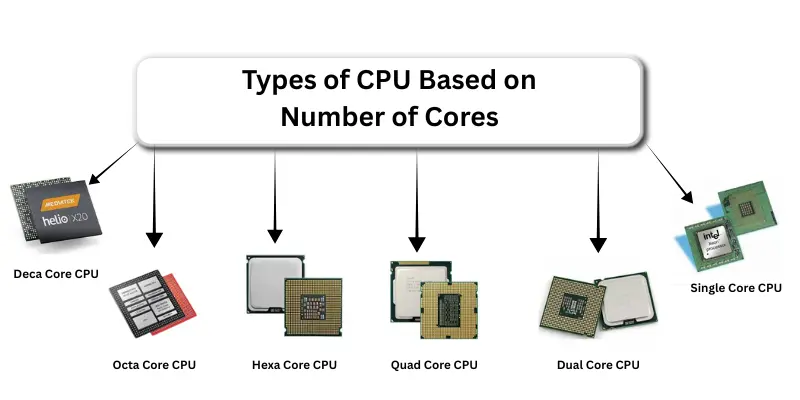
1. Single Core CPU
A single core CPU has only one core to process all tasks. It was widely used in early computers. This type of CPU performs one task at a time. It is suitable for basic and simple work only.
Three Examples of Single Core CPU
- Intel Pentium 4
- Intel Celeron (older models)
- AMD Sempron
Five Characteristics of Single Core CPU
- It has only one processing core
- It handles one task at a time
- It is slow for multitasking
- It uses low power
- It suits basic computing needs
2. Dual Core CPU
A dual core CPU contains two cores inside one processor. These two cores can work together. This allows the computer to perform two tasks at the same time. It offers better speed than a single-core CPU.
Three Examples of Dual-Core CPU
- Intel Core 2 Duo
- AMD Athlon X2
- Intel Pentium Dual-Core
Five Characteristics of Dual Core CPU
- It has two working cores
- It supports basic multitasking
- It runs faster than single-core CPUs
- It consumes moderate power
- It fits home and student use
3. Quad Core CPU
A quad core CPU has four cores. It can run multiple programs smoothly. Many modern laptops and desktops use this type of CPU. It provides good performance for daily work and light gaming.
Three Examples of Quad-Core CPU
- Intel Core i5
- AMD Ryzen 3
- Apple A10 Fusion
Five Characteristics of Quad Core CPU
- It has four processing cores
- It handles multitasking efficiently
- It supports gaming and editing tasks
- It gives balanced performance
- It is common in modern computers
4. Hexa Core CPU
A hexa core CPU comes with six cores. It is designed for users who need more power. This CPU handles heavy software and multitasking smoothly.
Three Examples of Hexa Core CPU
- AMD Ryzen 5 3600
- Intel Core i5 (10th Gen and above)
- Apple A12 Bionic
Five Characteristics of Hexa Core CPU
- It includes six strong cores
- It manages heavy tasks easily
- It performs well in gaming
- It improves multitasking speed
- It uses more power than quad-core
5. Octa Core CPU
An octa core CPU has eight cores. It is widely used in high end smartphones and computers. This CPU type handles advanced tasks like gaming, video editing, and streaming.
Three Examples of Octa Core CPU
- Intel Core i7
- Qualcomm Snapdragon 865
- Samsung Exynos 990
Five Characteristics of Octa Core CPU
- It has eight powerful cores
- It supports high level multitasking
- It works well for gaming and editing
- It delivers fast performance
- It consumes higher power
6. Deca Core CPU
A deca core CPU contains ten cores. It is built for advanced and professional tasks. These CPUs are mostly used in flagship mobiles, servers, and high end systems.
Three Examples of Deca Core CPU
- MediaTek Dimensity 1000+
- Intel Core i9 (selected models)
- Apple M1 Pro (10-core variant)
Five Characteristics of Deca Core CPU
- It has ten processing cores
- It handles very heavy workloads
- It supports professional applications
- It offers excellent multitasking
- It requires more energy
Types of CPU Based on Device
CPUs are also classified based on the device where they are used. Different devices have different needs. Some devices need high power, while others need low power to save battery. Because of this, CPU makers design special processors for desktops, laptops, and mobile devices. Below, the types of CPU based on the device are explained with clear introductions, examples, and characteristics.
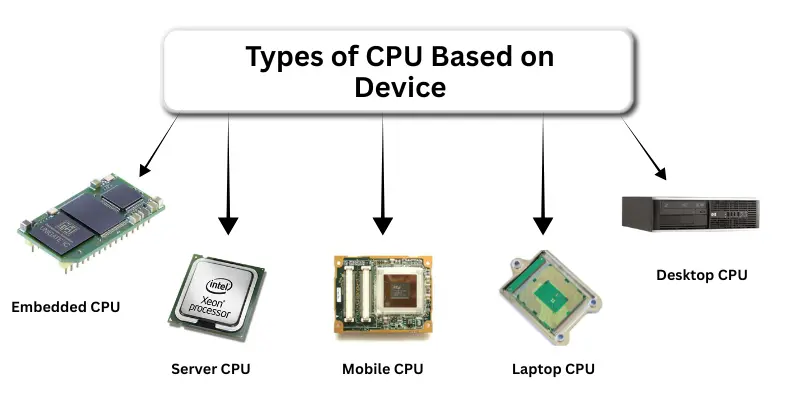
1. Desktop CPU
A desktop CPU is designed for desktop computers. It focuses on high performance and speed. These CPUs are larger in size and use more power. They are suitable for gaming, office work, and professional tasks.
Three Examples of Desktop CPU
- Intel Core i5
- AMD Ryzen 7
- Intel Core i9
Five Characteristics of Desktop CPU
- It delivers high performance
- It supports heavy software
- It allows easy upgrades
- It consumes more power
- It needs proper cooling
2. Laptop CPU
A laptop CPU is specially made for laptops. It balances performance and power saving. These CPUs are smaller and generate less heat. They help laptops run longer on a battery.
Three Examples of Laptop CPU
- Intel Core i5 U Series
- AMD Ryzen 5 Mobile
- Intel Core i7 Mobile
Five Characteristics of Laptop CPU
- It saves battery power
- It produces less heat
- It has a compact size
- It supports daily tasks well
- It offers moderate performance
3. Mobile CPU (Smartphone Processor)
A mobile CPU is used in smartphones and tablets. It is also called a System on a Chip (SoC). It combines CPU cores, GPU, and other components into one chip. It focuses on power efficiency and multitasking.
Three Examples of Mobile CPU
- Qualcomm Snapdragon 8 Gen 1
- Apple A15 Bionic
- MediaTek Dimensity 900
Five Characteristics of Mobile CPU
- It uses very low power
- It supports multitasking apps
- It handles graphics and AI tasks
- It fits in small devices
- It improves battery life
4. Server CPU
A server CPU is built for servers and data centers. It handles multiple users and tasks simultaneously. These CPUs prioritize stability and consistent performance.
Three Examples of Server CPU
- Intel Xeon
- AMD EPYC
- IBM Power9
Five Characteristics of Server CPU
- It supports multiple users
- It runs continuously without rest
- It handles large data loads
- It offers high reliability
- It consumes high power
5. Embedded CPU
An embedded CPU is used in special devices, not regular computers. These devices include ATMs, washing machines, cars, and medical equipment. The CPU performs a fixed function.
Three Examples of Embedded CPU
- ARM Cortex M series
- Intel Atom
- Microchip PIC processors
Five Characteristics of Embedded CPU
- It performs specific tasks
- It uses very low power
- It has a small size
- It runs simple programs
- It works for long periods
Types of CPU Based on Architecture
CPUs can also be classified based on their architecture. CPU architecture defines how the CPU processes data and communicates with memory and other parts of the computer. The two main types of CPU architecture are 32bit and 64 bit. Branded computers mostly use 64bit CPUs. It is faster and can handle larger programs and more memory. Learn CPU architecture helps in choosing the right processor for your device.
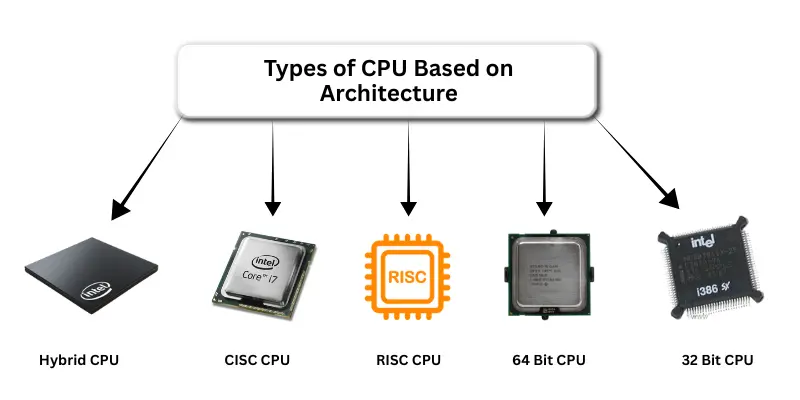
1. 32 Bit CPU
A 32 bit CPU processes data in 32 bit chunks. It was widely used in older computers and laptops. These CPUs can only handle up to 4GB of RAM, which limits their performance for modern software.
Three Examples of 32 Bit CPU
- Intel Pentium 4
- AMD Athlon XP
- VIA C7
Five Characteristics of 32 Bit CPU
- Processes 32 bits of data at a time
- Limited to 4GB maximum memory
- Supports older operating systems and software
- Slower for modern applications
- Mostly found in legacy systems
2. 64 Bit CPU
A 64-bit CPU processes data in 64-bit chunks. It is widely used in modern desktops, laptops, and servers. These CPUs can handle more RAM and larger programs efficiently.
Three Examples of 64 Bit CPU
- Intel Core i7 (modern series)
- AMD Ryzen 5/7
- Apple M1 / M2
Five Characteristics of 64 Bit CPU
- Processes 64 bits of data at a time
- Supports more than 4GB RAM
- Runs modern operating systems and software
- Faster performance for multitasking
- Suitable for gaming, video editing, and professional work
3. RISC CPU
A RISC stands for Reduced Instruction Set Computing. RISC CPU uses a simplified set of instructions to process data quickly. It is energy-efficient and widely used in mobile devices and embedded systems.
Three Examples of RISC CPU
- ARM Cortex A series
- Apple A series (A14, A15)
- Qualcomm Snapdragon
Five Characteristics of RISC CPU
- Uses fewer instructions per task
- Energy efficient and low power
- High performance in mobile devices
- Simpler design reduces cost
- Ideal for smartphones, tablets, and embedded systems
4. CISC CPU
A CISC stands for Complex Instruction Set Computing. A CISC CPU can perform complex instructions with a single command. It is often used in desktop and server computers where speed and versatility are important.
Three Examples of CISC CPU
- Intel Core i5 / i7
- AMD Ryzen series
- IBM PowerPC
Five Characteristics of CISC CPU
- Supports complex instructions
- Performs multiple tasks per command
- Powerful for desktops and servers
- Slightly higher power consumption
- Handles large software efficiently
5. Hybrid CPU Architecture
Some modern CPUs combine RISC and CISC architectures to get the benefits of both. These are often found in smartphones, tablets, and new laptops.
Three Examples of Hybrid CPU
- Apple M1 / M2
- Intel Lakefield
- Qualcomm Snapdragon 8 Gen 1
Five Characteristics of a Hybrid CPU
- Combines simplicity and complex instruction sets
- Energy efficient and powerful
- Supports multitasking and heavy apps
- Used in modern laptops and mobile devices
- Reduces power consumption while boosting performance
Conclusion
There are different types of CPU based on cores, from single core to deca cor,e and each offers unique performance levels for multitasking and heavy workloads. CPUs are also classified by device type, such as desktop, laptop, mobile, server, and embedded CPUs, each designed for specific needs. Finally, CPU architecture, like 32-bit, 64-bit, RISC, CISC, or hybrid, determines how efficiently a CPU processes data.
FAQs about Types of CPU
A core is a processing unit inside the CPU. More cores mean faster performance and better multitasking.
A deca core CPU has ten cores and is used for heavy workloads, servers, high-end smartphones, and professional computers.
32-bit CPUs can handle up to 4GB of RAM and older software, while 64-bit CPUs support more memory and modern applications efficiently.
Popular CPU manufacturers include Intel, AMD, Apple, Qualcomm, and MediaTek.
A hybrid CPU combines RISC and CISC architectures, giving both energy efficiency and high performance, mostly used in modern laptops and mobile devices.
You can check CPU cores using system information tools on Windows, macOS, or smartphones. It will show the number of cores and threads.
More CPU cores allow better multitasking, faster processing, and smoother performance in gaming, video editing, and professional software.