Types of Headphones
Published: 5 Feb 2026
Headphones play an important role in daily life. Many people use them for music, study, calls, and games. Different designs serve different needs. Each style offers a unique listening experience. Learning about the types of headphones helps people choose the right option. Here is more information about the types of speakers on EC Science.
15 Types of Headphones
Many boys and girls like different types of headphones. Below is a complete explanation of headphone types, features, and characteristics for beginners.
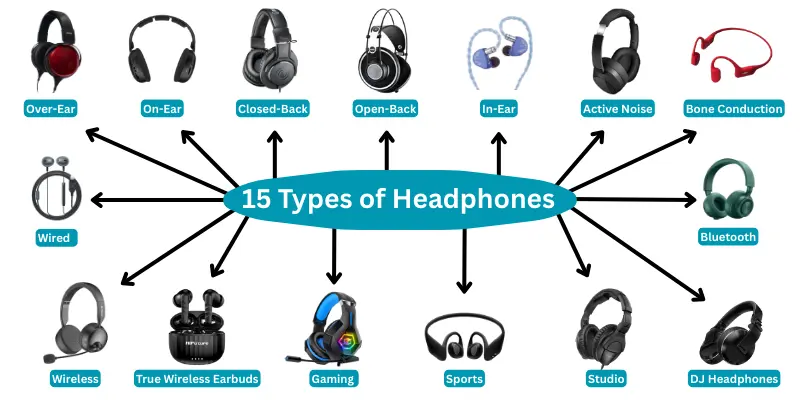
- Over-Ear (Circumaural)
- On-Ear (Supra-aural)
- In-Ear (Earbuds/IEMs)
- Closed-Back
- Open-Back
- Active Noise-Cancelling (ANC)
- Bone Conduction
- Wired Headphones
- Wireless Headphones
- True Wireless Earbuds
- Gaming Headphones
- Sports Headphones
- Studio Headphones
- DJ Headphones
- Bluetooth Headphones
1. Over-Ear Headphones (Circumaural)
Over-ear headphones fully cover the ears. They are used for music, gaming, and studio work. Popular brands include Sony, Bose, and Sennheiser. They are made by companies like Sony Corporation and Bose Corporation. The following features and characteristics are included.
10 Features of Over-Ear Headphones
- Full ear coverage
- Large ear pads
- High-quality sound
- Comfortable for long use
- Noise isolation
- Wired or wireless option
- Strong bass response
- Durable build
- Adjustable headband
- Folding design for storage
10 Characteristics of Over-Ear Headphones
- Heavyweight design
- Immersive audio
- Clear sound clarity
- Good for long listening
- Strong noise isolation
- Professional use in studios
- Large size
- Expensive models available
- Long-lasting comfort
- Stylish appearance
2. On-Ear Headphones (Supra-aural)
On-ear headphones rest on the ears. They are used for casual music and travel. Popular brands include JBL, Beats, and Skullcandy. Made by JBL, Beats Electronics, and Skullcandy Inc. The following features and characteristics are included.
10 Features of On-Ear Headphones
- Medium size
- Light weight
- Soft ear pads
- Portable design
- Wired and wireless options
- Adjustable headband
- Clear mid-range sound
- Foldable for storage
- Battery-powered for wireless models
- Easy to carry
10 Characteristics of On-Ear Headphones
- Rest on the ears, not cover
- Moderate sound isolation
- Comfortable for short use
- Travel-friendly
- Affordable options
- Stylish designs
- Clear sound for calls
- Less bulky than over-ear
- Lightweight
- Available in many colours
3. In-Ear Headphones (Earbuds/IEMs)
In-ear headphones fit inside the ear canal. They are used for daily music, calls, and travel. Popular brands include Apple AirPods, Sony, and Samsung. Made by Apple Inc., Sony Corporation, and Samsung Electronics. The following features and characteristics are included.
10 Features of In-Ear Headphones
- Small size
- Fits inside the ear
- Portable
- Wired or wireless
- Lightweight
- Noise isolation
- Easy storage
- Quick charging for wireless
- Comfortable for short use
- Affordable options
10 Characteristics of In-Ear Headphones
- Compact design
- Easy to carry
- Good for travel
- Direct sound to the ear
- Budget-friendly
- Multiple colour options
- Quick connectivity (wireless)
- Can be lost easily
- Short listening comfort
- Commonly used with smartphones
4. Closed Back Headphones
Closed-back headphones have sealed ear cups. They are mainly used for music recording and studio work. Brands include Audio-Technica, Sony, and Sennheiser. Made by Audio Technica Co., Sony Corporation, and Sennheiser Electronics. The following features and characteristics are included.
10 Features of Closed-Back Headphones
- Sealed ear cups
- Noise isolation
- Wired models
- High-quality sound
- Comfortable padding
- Adjustable headband
- Durable design
- Strong bass output
- Professional use
- Studio friendly
10 Characteristics of Closed-Back Headphones
- Blocks outside noise
- Good for recording
- Heavyweight design
- Long listening comfort
- Clear sound
- Focused audio
- Not for outdoor use
- Premium models
- Strong build quality
- Professional look
5. Open-Back Headphones
Open-back headphones allow air and sound to pass through. They are used for home listening and studio mixing. Brands include Sennheiser, AKG, and Beyerdynamic. Made by Sennheiser, AKG Acoustics, and Beyerdynamic GmbH. The following features and characteristics are included.
10 Features of Open-Back Headphones
- Open ear cups
- Airflow design
- Wide sound stage
- High-fidelity sound
- Comfortable padding
- Adjustable headband
- Wired connection
- Light weight
- Natural sound quality
- Durable build
10 Characteristics of Open-Back Headphones
- Sound leaks outside
- Best for quiet spaces
- Spacious audio
- Comfortable for long use
- Not suitable for travel
- Professional listening
- High-quality material
- Detailed sound clarity
- Lightweight
- Premium appearance
6. Active Noise-Cancelling (ANC)
Active Noise-Cancelling (ANC) headphones use built-in microphones to detect outside noise and produce an opposite sound wave to cancel it out. They are used for travel, office work, commuting, and focused study. Leading brands include Sony, Bose, Apple, JBL, and Skullcandy.
The technology has evolved significantly. Modern ANC headphones now feature Adaptive ANC, which automatically adjusts cancellation strength in real time based on the environment from a quiet library to a loud airplane. Multi-level ANC modes (Light, Moderate, Max) let users balance awareness with isolation.
Flagship models like the Sony WH-1000XM6 and the Bose QuietComfort Ultra Gen 2 set the current benchmark, with the XM6 adding 360 Reality Audio Upmix for Cinema and LE Audio / Auracast Bluetooth support.
10 Features of Active Noise-Cancelling
- Adaptive ANC with real-time environment detection
- Multi-level ANC modes (Light / Moderate / Max)
- Wireless Bluetooth with LE Audio support
- Spatial audio and Dolby Atmos compatibility
- Comfortable memory-foam ear pads
- 30–40 hour battery life with ANC enabled
- Quick charge (5–10 minutes for 1–2 hours playback)
- Transparency / Awareness mode to hear surroundings
- Foldable travel-friendly design
- Touch and voice controls
10 Characteristics of Active Noise-Cancelling
- Blocks low-frequency noise (engine hum, AC, crowd)
- Reduces background noise by up to 46 dB (premium models)
- Battery-powered — requires regular charging
- Works best on airplanes, trains, and busy offices
- More effective than passive noise isolation
- Transparency mode lets ambient sound in naturally
- Premium models are expensive (typically $200–$450)
- Some ANC can cause a pressure sensation for sensitive users
- Flagship models now include AI-powered sound personalization
- Works with voice assistants (Siri, Google, Alexa)
7. Bone Conduction Headphones
Bone conduction headphones transmit sound through cheekbone vibrations directly to the inner ear, bypassing the eardrum entirely. This leaves the ear canal completely open, making them ideal for running, cycling, hiking, and any outdoor activity where hearing your surroundings is a safety priority. The leading brand is Shokz (formerly AfterShokz), with other notable names including Suunto and H2O Audio.
The technology has advanced well beyond simple vibration. The Shokz OpenRun Pro 2 introduced DualPitch™ Technology, which pairs a bone conduction driver for clear mids and highs with a dedicated air conduction speaker for deep bass addressing the one weakness that pure bone conduction has always had. It also features USB-C fast charging (5 minutes for 1.5 hours of use) and a full 12-hour battery.
Models like the Shokz OpenSwim Pro add full waterproofing with onboard MP3 storage for pool and open-water swimming.
10 Features of Bone Conduction Headphones
- Open-ear design ear canal stays completely free
- Hybrid DualPitch™ technology (bone + air conduction drivers)
- IP55–IP68 water and sweat resistance
- Bluetooth wireless connectivity
- USB-C fast charging
- Up to 12 hours battery life (flagship models)
- 6 EQ modes plus customizable profiles
- Lightweight wraparound frame
- Reflective strips for low-light safety (sport models)
- Onboard MP3 storage (swim-specific models)
10 Characteristics of Bone Conduction Headphones
- Full awareness of surroundings ideal for road safety
- Some sound leakage at high volumes in quiet environments
- Vibration sensation at very high volumes (reduced in newer hybrid models)
- Not suitable for swimming unless specifically rated (e.g., OpenSwim Pro)
- Best suited for podcasts, calls, and mid-range heavy audio
- Bass response still weaker than sealed headphones, even in hybrid models
- Comfortable for glasses and earring wearers
- Popular with runners, cyclists, military, and warehouse workers
- Not recommended for quiet studio work (sound leakage)
- Premium models range from $100–$250
8. Wired Headphones
Wired headphones connect with a cable. They are used for music, calls, and gaming. Brands include Sony, Audio-Technica, and JBL. Made by Sony Corporation, Audio-Technica, and JBL. The following features and characteristics are included.
10 Features of Wired Headphones
- Cable connection
- Plug-and-play
- No battery needed
- Clear sound
- Comfortable padding
- Durable cord
- Lightweight
- High-fidelity audio
- Affordable
- Long-lasting
10 Characteristics of Wired Headphones
- Reliable sound
- No charging needed
- Simple design
- Compatible with many devices
- Heavy bass
- Portable
- Easy storage
- Long cable options
- Durable
- Everyday use
9. Wireless Headphones
Wireless headphones connect via Bluetooth. They are used for music, study, and calls. Brands include Sony, Bose, and JBL. Made by Sony Corporation, Bose Corporation, and JBL. The following features and characteristics are included.
10 Features of Wireless Headphones
- Bluetooth connectivity
- No wires
- Comfortable ear pads
- Foldable design
- Long battery life
- Touch controls
- Lightweight
- Portable
- Clear audio
- Easy pairing
10 Characteristics of Wireless Headphones
- Freedom of movement
- Easy to carry
- Stylish design
- Rechargeable battery
- Wireless convenience
- Travel-friendly
- Multi-device support
- Durable
- Comfortable for long use
- Expensive models
10. True Wireless Earbuds
True wireless earbuds (TWS) have no wires at all not even between the two earbuds. They connect entirely over Bluetooth and come with a compact charging case that also extends battery life. They are used for travel, workouts, commuting, calls, and everyday listening. Top brands include Apple (AirPods Pro), Samsung (Galaxy Buds 4 Pro), Sony (WF-1000XM5), Sennheiser (MOMENTUM True Wireless 4), and Nothing.
The TWS category has evolved into smart wearable devices. Bluetooth 5.4 is now widely adopted in premium earbuds, bringing 2x faster data transfer and ultra-low latency compared to 5.3. High-resolution audio codecs like LDAC (Sony) and aptX Lossless (Sennheiser) now deliver near-CD quality wirelessly.
AI-powered microphone arrays deliver clear calls even in loud environments, while health features including heart rate monitoring (Powerbeats Pro 2), head gesture control (Galaxy Buds 4 Pro), and personalized spatial audio (AirPods Pro 2) have made TWS earbuds a genuine lifestyle device. Multi-point connection lets users pair two devices simultaneously, switching seamlessly between a phone and laptop.
10 Features of True Wireless Earbuds
- Fully wireless no cable between earbuds
- Bluetooth 5.4 for stable, low-latency connection
- LDAC / aptX Lossless for hi-res wireless audio
- Active Noise Cancellation with Transparency mode
- Compact charging case with wireless Qi charging
- Multipoint connection (two devices simultaneously)
- AI-enhanced microphones for clear call quality
- Personalized Spatial Audio with head tracking
- Health sensors (heart rate, activity, gesture control select models)
- IPX4–IP57 water resistance
10 Characteristics of True Wireless Earbuds
- Most portable form factor fits in any pocket
- Battery: 6–10 hours per charge; 24–36 hours total with case
- Can be lost easily due to small size
- Less isolation and bass than over-ear headphones
- Best-in-class ANC still slightly below premium over-ears
- Premium models ($200–$300) are competitive with over-ear quality
- Ecosystem integration important (Apple buds best with iPhone; Samsung buds best with Galaxy)
- LDAC earbuds require a compatible source device for hi-res playback
- Health monitoring features vary widely by model and price
- Firmware updates frequently add new features post-purchase
11. Gaming Headphones
Gaming headphones are purpose-built for gaming, streaming, and online communication. They combine high-quality positional audio with a clear microphone for in-game communication and content creation. Popular brands include Razer, SteelSeries, Logitech G, HyperX, Astro, and Corsair.
The key distinction for serious gamers is connection type. Wired USB headsets deliver lossless audio with no latency and are preferred for competitive play. Wireless gaming headsets using 2.4 GHz USB dongles (not standard Bluetooth) offer the same latency performance as wired, making them the top choice for console and PC gaming without cables.
Standard Bluetooth wireless headsets introduce enough latency to be noticeable in fast-paced games. Surround sound formats have also matured. Dolby Atmos and DTS:X are now supported on both PC and consoles, with software processing turning stereo drivers into positional 7.1 virtual surround. Detachable microphones are now common, allowing dual-use as music headphones.
10 Features of Gaming Headphones
- Detachable or retractable noise-isolating microphone
- Virtual 7.1 surround sound (Dolby Atmos / DTS:X)
- Low-latency 2.4 GHz wireless dongle (premium models)
- USB-C or USB-A connection for wired models
- Broad multi-platform compatibility (PC, PS5, Xbox, Switch)
- Memory-foam ear cups for extended sessions
- Onboard controls (volume wheel, mic mute)
- RGB lighting (entry/mid-range models)
- Companion app with EQ and surround customization
- 20–30 hour wireless battery life
10 Characteristics of Gaming Headphones
- Optimized for directional audio cues (footsteps, gunfire)
- 2.4 GHz wireless matches wired latency performance
- Standard Bluetooth not recommended for competitive gaming
- Heavier and bulkier than everyday headphones
- Wide headband for all-day comfort during long sessions
- Microphone quality varies widely check reviews before buying
- USB connection provides the cleanest signal for PC
- 3.5mm jack essential for Nintendo Switch and controller use
- Software EQ customization improves competitive performance
- Not ideal for commuting or casual use due to size
12. Sports Headphones
Wireless headphones connect to devices via Bluetooth without any audio cable. They cover both over-ear and on-ear designs and are used for music, study, commuting, calls, and travel. Leading brands include Sony, Bose, JBL, Apple, Sennheiser, and Bowers & Wilkins.
Modern wireless headphones support Bluetooth Multipoint, allowing connection to two devices at the same time for example, a laptop and a phone with automatic switching when a call comes in. The latest LE Audio with LC3 codec (found in flagship models like the Sony WH-1000XM6) delivers better audio quality at lower power consumption than the older SBC codec.
Battery life has also improved: 30–40 hours per charge is now standard in the mid-to-premium tier. Wireless headphones increasingly overlap with ANC models, as active noise cancellation is expected in any over-ear wireless product above $100.
10 Features of Sports Headphones
- Bluetooth 5.2–5.4 with LE Audio / LC3 codec support
- Bluetooth Multipoint (connect two devices simultaneously)
- 30–40 hour battery life (flagship models)
- USB-C charging with quick charge support
- Active Noise Cancellation (standard above $100)
- Foldable, compact design for travel
- Touch and button controls on ear cups
- Voice assistant integration (Siri, Google, Alexa)
- Companion app with EQ and personalization
- NFC tap-to-pair (select models)
10 Characteristics of Sports Headphones
- No cables freedom of movement up to 10 meters
- Sound quality is now comparable to wired at equivalent price points
- Battery must be charged regularly (USB-C is now standard)
- Multipoint allows seamless switching between phone and laptop
- Higher price than wired equivalents at same audio quality level
- LE Audio codec delivers improved clarity at lower power draw
- Over-ear wireless models offer the best comfort for long use
- Some models support wired fallback via 3.5mm for long flights
- Strong ANC performance now expected across most price tiers
- Ideal for commuters, remote workers, and students
13. Studio Headphones
Studio headphones are for music recording and editing. They give precise sound. Brands include Audio-Technica, Beyerdynamic, and Sony. Made by Audio-Technica, Beyerdynamic GmbH, and Sony Corporation. The following features and characteristics are included.
10 Features of Studio Headphones
- High-fidelity audio
- Closed or open-back
- Comfortable padding
- Long listening comfort
- Accurate sound
- Wired connection
- Adjustable headband
- Durable design
- Lightweight
- Professional use
10 Characteristics of Studio Headphones
- Precise sound
- Clear highs and lows
- Good for mixing
- Professional-grade materials
- Comfortable for long use
- Heavy duty
- Studio oriented
- Neutral sound profile
- High-quality build
- Long lasting
14. DJ Headphones
DJ headphones are for live music and DJing. They are strong and durable. Brands include Pioneer, Sennheiser, and Sony. Made by Pioneer DJ, Sennheiser, and Sony Corporation. The following features and characteristics are included.
10 Features of DJ Headphones
- Swivel ear cups
- Strong bass
- Noise isolation
- Comfortable padding
- Durable build
- Wired connection
- Adjustable headband
- Foldable for travel
- High-volume handling
- Lightweight
10 Characteristics of DJ Headphones
- Large ear cups
- Professional DJ use
- Heavy bass
- Long-lasting comfort
- Travel-friendly
- Durable materials
- Stylish design
- Clear sound
- Good for mixing
- Strong build
15. Bluetooth Headphones
Bluetooth headphones connect to devices wirelessly. They are used for music, calls, and study. Brands include Sony, JBL, and Bose. Made by Sony Corporation, JBL, and Bose Corporation.
10 Features of Bluetooth Headphones
- Bluetooth connectivity
- Wireless design
- Comfortable ear pads
- Foldable for storage
- Rechargeable battery
- Long battery life
- Portable
- Clear sound
- Touch controls
- Lightweight
10 Characteristics of Bluetooth Headphones
- Wireless freedom
- Easy pairing
- Travel-friendly
- Stylish design
- Comfortable fit
- Durable materials
- Multi-device support
- Long-lasting
- Professional look
- Convenient use
Conclusion
There are many types of headphones. Each type is made for a specific purpose. Some are for music, some for gaming, and some for sports. Brands like Sony, Bose, JBL, and Apple make popular headphones. They are used by students, professionals, and travellers. Features like comfort, sound quality, and wireless support make them useful. Characteristics like size, weight, and noise control help people choose the right one. Knowing the types of headphones helps everyone select the best fit for their needs.
FAQs about Types of Headphones
Many people wonder about the different types of headphones. Here are FAQs to help everyone pick the best headphones.
Headphones are devices that let a person listen to sound privately. They are made to cover or fit inside the ears. Some are wired, and some are wireless.
There are many headphones, but three common types are:
- Over-Ear Headphones
- On-Ear Headphones
- In-Ear Headphones
Five popular types of headphones are:
- Over-Ear Headphones
- On-Ear Headphones
- In-Ear Headphones
- Wireless Headphones
- True Wireless Earbuds
The best headphones depend on what you need.
- For music: Over-Ear Headphones
- For gaming: Gaming Headphones
- For travel: Noise-Cancelling Headphones
- For sports: Sports Headphones
- For daily calls: In-Ear or Bluetooth Headphones
Headphones have many advantages. They make listening easy and private:
- Clear sound
- Private listening
- Portable and easy to carry
- Wireless freedom (if wireless)
- Noise reduction (some types)
- Comfortable for long use
- Good for study or work
- Can be used for gaming
- Affordable options available
- Stylish designs
Headphones also have disadvantages. They can cause problems if misused:
- Ear strain from long use
- Hearing damage at high volume
- Some are heavy or uncomfortable
- Can break easily
- Battery needed (for wireless)
- Easy to lose small earbuds
- Not all block noise
- Some are expensive
- Wires can tangle (for wired)
- Limited comfort for sports
Headphones are used in many ways. Five main uses are:
- Listening to music
- Gaming and online streaming
- Watching movies or videos
- Making or receiving calls
- Studying or online classes
Headphones have many features. Five key features are:
- Comfortable ear pads
- Clear sound quality
- Wired or wireless option
- Noise isolation or cancellation
- Adjustable headband
Headphones have unique characteristics. Five main characteristics are:
- Lightweight or heavy, depending on type
- Cover ears or fit inside ears
- Portable and easy to carry
- Durable materials
- Different sound quality (bass, treble, clarity)
Headphones have several main parts. Common parts include:
- Ear cups or earbuds
- Headband or strap
- Speaker drivers
- Wire or cable (if wired)
- Microphone (optional)
- Control buttons (volume, play/pause)
- Battery (for wireless)
- Charging port (for wireless)
- Ear cushions
- Connector plug (3.5mm, USB, or Bluetooth)
Active Noise Cancellation (ANC) uses small microphones to detect outside noise and generates an opposite sound wave to cancel it electronically. It works best on low-frequency, constant sounds like airplane engines, trains, and air conditioning. Passive noise isolation is simply the physical blocking of sound by the ear cups or ear tips pressing against or around the ear.
Closed-back and in-ear headphones rely on passive isolation. Many premium headphones combine both for the best overall noise blocking.
For studying or working from home, ANC over-ear headphones are the most effective choice. They block background noise like household sounds, traffic, and conversations, helping with focus. Look for models with a long battery life (30+ hours), comfortable ear pads for extended wear, and a built-in microphone for calls.
The Sony WH-1000XM6, Bose QuietComfort Ultra Gen 2, and JBL Live 780NC are currently among the top-rated options for this use case. True wireless earbuds with ANC are a lighter alternative for shorter sessions.
Yes, bone conduction headphones are generally considered safer for long-term hearing health than traditional headphones. Because they do not insert into the ear canal or seal over the ear, they do not direct sound pressure directly at the eardrum. They transmit audio through cheekbone vibrations to the cochlea, bypassing the eardrum entirely.
However, listening at very high volumes for extended periods can still cause vibration fatigue and potentially affect hearing over time. Using them at moderate volumes is recommended. They are especially recommended for people with conductive hearing loss or those who wear hearing aids.